Flesh-Eating pest threatens Texas livestock and wildlife
By Anthony Collins
LPR Editor
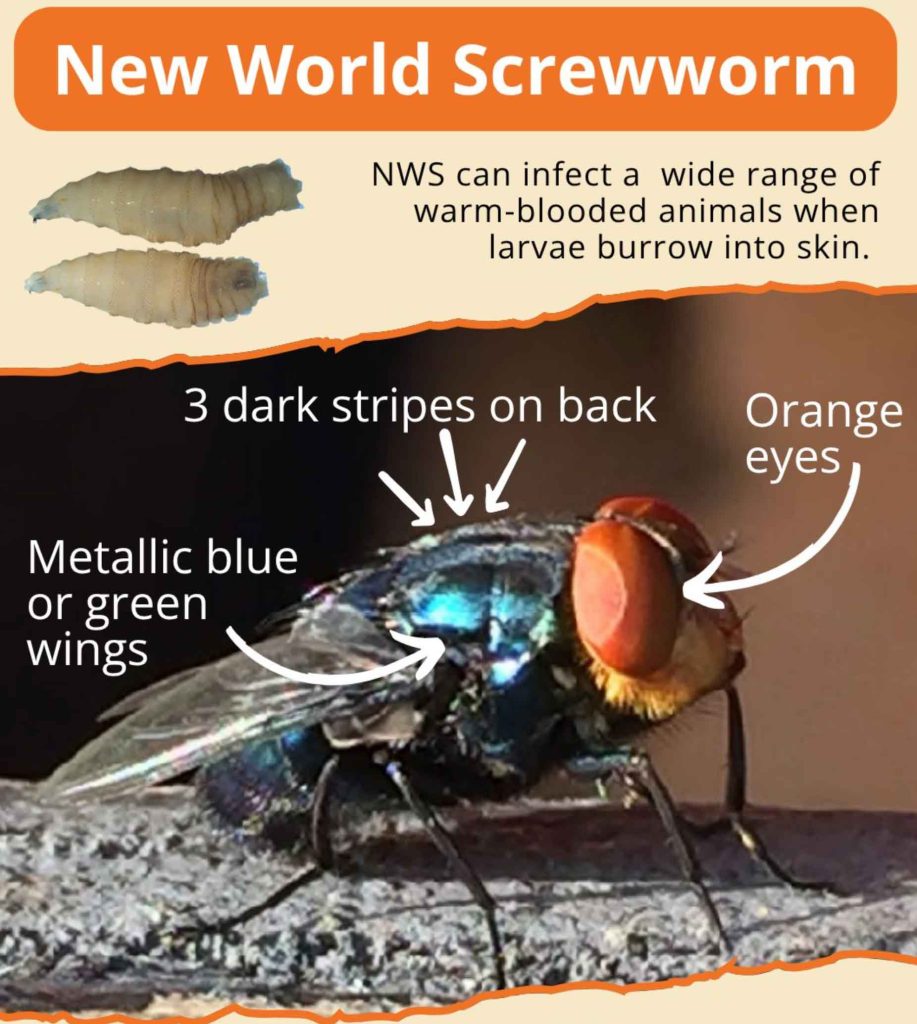
Texas ranchers and wildlife experts are bracing for the possible return of a deadly livestock parasite once eradicated from the United States more than half a century ago. The New World screwworm, a flesh-eating fly that infests warm-blooded animals, has been detected in southern Mexico and is moving steadily north toward the Texas border.
State and federal officials have launched an aggressive response to prevent the pest’s reestablishment, which could cost the Texas cattle industry more than $2 billion annually and inflict an additional $9 billion blow to wildlife, hunting, and rural tourism.
The screwworm fly lays its eggs in open wounds on animals including cattle, deer, goats, and even pets. The larvae feed on living tissue, causing severe injury and often death if left untreated. Recent cases in Veracruz and Oaxaca, less than 700 miles from Texas, prompted the U.S. Department of Agriculture (USDA) to suspend imports of live cattle, horses, and bison from Mexico.
Governor Greg Abbott has directed the Texas Animal Health Commission and Texas Parks and Wildlife Department to form a specialized Screwworm Response Team to increase surveillance, public outreach, and rapid-response capacity.
“The risk is real,” said Dr. Roel Lopez of the Texas A&M Natural Resources Institute. “This pest doesn’t respect borders, and it moves silently until it’s too late. We have a small window of time to act.”
For some ranchers, the threat stirs memories of past outbreaks. Chuck Dale, a third-generation rancher near Bastrop, recalls the grisly task of treating infested cattle alongside his father decades ago. “It’s nasty. It stinks. It’s gross,” Dale said. “I’m absolutely terrified it’s coming back.”
Last Thursday, U.S. Secretary of Agriculture Brooke Rollins joined Gov. Abbott in announcing $850 million in federal funding to combat the screwworm threat. The package includes $750 million to build a domestic sterile-fly production facility at Moore Air Base in Edinburg, Texas.
The facility is expected to produce 300 million sterile male flies weekly by year’s end, which will be released to mate with wild females, breaking the reproductive cycle. A second production site in Mexico will add another 100 million sterile flies by 2026.
Texas & Southwestern Cattle Raisers Association President Carl Ray Polk Jr. called the investment critical. “This is a warranted investment given the financial consequences to our agricultural economy, wildlife populations, and public health,” Polk said.
Currently, the only operating sterile fly facility in the world is in Panama, producing 115 million flies weekly, far short of what would be required to contain a U.S. outbreak. While the new facility is a major step forward, industry leaders warn that time is short. Cooper Little, executive director of the Independent Cattlemen’s Association, said inconsistent border inspection protocols leave ranchers vulnerable.
“We need a clear, science-driven biosecurity strategy, not reactive border policy shaped by short-term political pressure,” Little said.
Experts are calling for:
•Continuous surveillance in high-risk areas of Mexico and along the Texas border.
•Stronger inter-agency coordination between USDA, Customs and Border Protection, and state animal health commissions.
•Immediate expansion of sterile fly releases.
•Enhanced rapid-response protocols to detect and contain outbreaks quickly.
Texas A&M veterinary experts are training ranchers to spot early signs of infestation: wounds that won’t heal, foul odors, restlessness, and visible larvae. “If you see it, isolate it, and call a vet immediately,” said Dr. Phillip Kaufman, professor of veterinary entomology.
As summer heat accelerates the fly’s reproductive cycle, officials stress that vigilance is critical. “By the time you see signs in your herd, it might already be too late,” Dale warned.
Dr. Lopez put it more bluntly: “We’ve beaten screwworm before. But we can’t afford to be complacent. We either stay ahead of it, or we get run over.”