A Texas warrior: Emerson Lockhart Vivion’s fight for victory
By Anthony Collins
LPR Editor
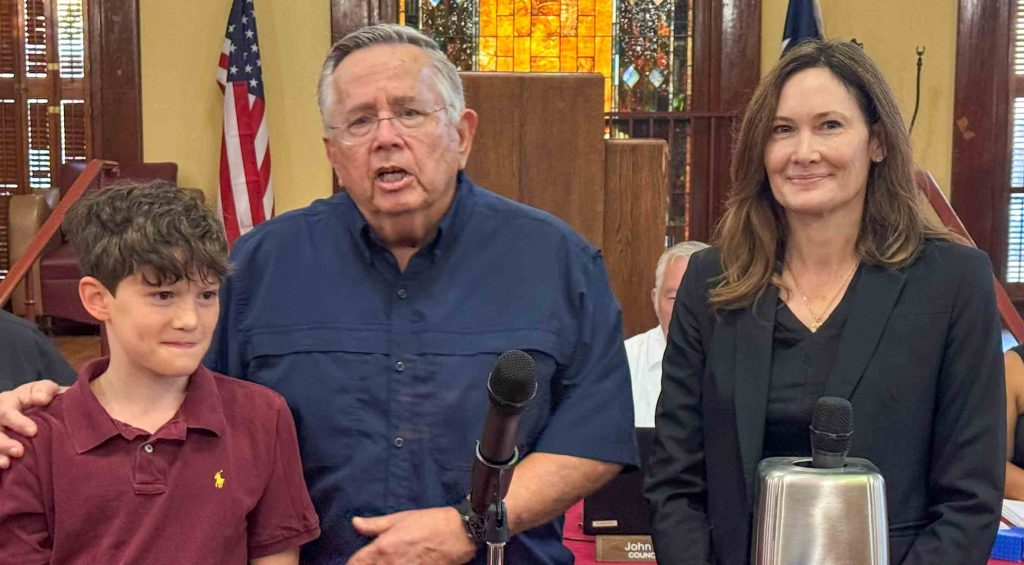
Above, Emerson Lockhart Vivion, Lockhart Mayor, Lew White and Erin Vivion are pictured at the Lockhart City Council Meeting held on October 8, 2026. Emerson, now 11 years old, was diagnosed with leukemia at the age of 8. Emerson, a descendant of Byrd Lockhart, jokingly considers himself “Texas Royalty” even though he lives in Washington.
Photo by City of Lockhart.
Nearly 200 years ago, Byrd Lockhart answered a call for help from the defenders of the Alamo, demonstrating the courage and determination that would become part of his legacy in Texas history.
Today, more than 2,000 miles away in Washington state, a young relative who carries the Lockhart name has written his own story of courage, perseverance, and survival.
Eleven-year-old Emerson Lockhart Vivion, a childhood cancer survivor from Mercer Island near Seattle, has a special connection to the community of Lockhart, one that reaches back to the Texas Revolution and the man for whom the city was named. That connection became even more meaningful Thursday night, October 8, when his mother, Erin Vivion, shared an emotional letter with the Lockhart City Council, thanking residents for supporting her son during the most difficult battle of his young life. Her words not only reflected a family’s gratitude but also offered a reminder that the spirit of a community can reach far beyond its city limits.
Emerson was just 8 years old when he was diagnosed with leukemia in May 2023, beginning an 873-day journey filled with chemotherapy treatments, hospital stays, and countless moments of uncertainty.
Much of the childhood he should have spent in classrooms, playing sports and enjoying time with friends was replaced by hospital rooms, medical equipment and treatments that often left him feeling terribly ill. During one particularly difficult hospital stay at Seattle Children’s Hospital, Emerson was receiving medication that required him to remain hospitalized and connected to an IV. The treatment caused painful mouth sores and made him feel sick, but his doctors encouraged him to remain active. Rather than stay in bed, Emerson climbed onto his favorite three-wheeled bicycle and began racing through the hospital hallways, his mother following closely behind while managing his IV pole and medical tubing. As he pedaled, he repeatedly shouted three words that would come to define his fight against cancer: “Never Give up!” It was a simple declaration from a young boy who had every reason to feel discouraged, yet refused to let the disease take away his determination.
It was during one of those hospital stays that Emerson learned something about his own family history that would change how he viewed himself and create an unexpected bond with a small Texas town.
A nurse whose mother taught at a Texas school recognized Emerson’s middle name, Lockhart, prompting his mother to explain the family’s connection to Byrd Lockhart. As she shared the story of their ancestor, Emerson listened from his hospital bed, hearing much of the history for the first time. According to his mother’s letter, his expression changed as he began to understand the significance of the family name. Finally, unable to contain his excitement, he interrupted with a question that would soon become part of his identity. “Um, Mom, are you saying that I am…. Texas Royalty?!” His mother looked at her son, bald from treatment, with a feeding tube taped to his face and connected to medical equipment, and gave him an answer he would never forget. “Yes, Emerson, you are.”
From that moment forward, the nickname “Texas Royalty” became something special among the nurses and doctors caring for him, giving Emerson a connection to a family history that stretched far beyond the walls of his hospital room.
According to his mother, Emerson is the great-great-great-great-great-grandnephew of Byrd Lockhart, the early Texas colonist, surveyor, and soldier who helped shape the region long before Caldwell County was established. Lockhart settled in Texas in 1826 and became an important figure in Green DeWitt’s colony, surveying land, establishing roads, and serving during the Texas Revolution. In February 1836, as Mexican forces threatened the Alamo, he was involved in efforts to support the defenders. His family’s account describes his role in organizing volunteers associated with the legendary Immortal 32, the men from Gonzales who entered the Alamo despite overwhelming odds. His service also included a dangerous mission outside the Alamo seeking additional supplies and assistance, an assignment that spared him from the fate of those killed when Mexican forces overwhelmed the fort on March 6, 1836. Byrd Lockhart continued serving the Texan army until his death in 1839. His name would live on when the Caldwell County community was named in his honor. For Emerson, learning about that history during one of the most difficult periods of his life gave him something positive to hold onto and a reason to take pride in the name he carried.
As Emerson continued his treatments, his story eventually made its way to Lockhart, where residents and city officials began reaching out to encourage the young boy. Videos of encouragement arrived from Texas, prayers were offered on his behalf, and Emerson’s name was mentioned during City Council meetings. His photograph was displayed at City Hall, and the community sent him a care package along with a certificate formally recognizing his family connection to Byrd Lockhart. Those gestures, though coming from people living nearly 2,000 miles away, became an important source of encouragement for a child who had been separated from so many ordinary parts of life. In her letter to the City Council, Erin Vivion described how much those acts of kindness meant to Emerson and his family. “True to the spirit of Byrd Lockhart and just like he answered a call for help nearly 200 years earlier, you answered Emerson’s,” she wrote. She explained that childhood cancer does more than threaten a child’s health. It takes away school, friendships, sports, and the freedom to simply be a kid, replacing those experiences with treatments and physical challenges that would be difficult even for adults. Through it all, Lockhart’s support reminded Emerson that people outside his hospital room were thinking about him, cheering for him, and hoping he would recover. “Your gestures made a real difference,” she told the council. “They made Emerson feel special and reminded him that he was supported and that he wasn’t fighting alone.”
Even during his own treatments, Emerson found ways to help other children going through similar experiences. Video games became one of the activities that helped him endure long hospital stays, giving him something enjoyable to focus on while dealing with the physical and emotional challenges of chemotherapy.
Recognizing the importance of those moments, he became involved in raising money for Seattle Children’s Therapeutic Gaming Program, which helps provide gaming experiences to hospitalized children. His efforts earned him a Community Day Hope Award from Seattle Children’s Hospital in March 2025, recognizing his willingness to help others despite facing serious health challenges of his own. His story attracted attention in the Seattle area, offering an example of how a young cancer patient could make a difference in the lives of others while continuing his own treatment. For Emerson, helping other children provided an opportunity to turn some of his most difficult experiences into something positive, demonstrating a sense of compassion that extended beyond his own circumstances.
On October 6, 2025, after an 873-day battle with leukemia, Emerson received his final chemotherapy treatment. Later that month, surrounded by family members, medical staff, and special guests, he rang the ceremonial bell outside Seattle Children’s Cancer and Blood Disorders Center, marking the completion of his cancer treatment. Former Seattle Seahawks linebacker Lofa Tatupu joined the celebration, while Seattle Mariners bullpen coach Tony Arnerich delivered a special video message congratulating Emerson on reaching the milestone. It was a moment filled with emotion for a family that had spent more than two years navigating the uncertainty of childhood cancer. For Emerson, completing treatment meant an opportunity to return to the things he loved, including school, friends, and sports, without the constant demands of chemotherapy. The milestone did not erase the difficult days, painful treatments, or sacrifices his family had endured, but it represented something they had worked toward since his diagnosis: the chance to look ahead with renewed hope.
Last Tuesday, October 6, marked one year since Emerson’s final chemotherapy dose, an anniversary his family celebrated while reflecting on everything he had endured. Two days later, his mother’s letter brought that journey back to the community that had helped encourage him. Drawing a comparison between Byrd Lockhart answering the call for help at the Alamo and the Lockhart community answering her son’s call nearly two centuries later, she expressed the family’s gratitude for the kindness shown to a young boy whom most residents had never met. “Thank you, Lockhart, for acknowledging and embracing Emerson as ‘Texas Royalty’ and sending in the reinforcements to inspire his will to keep fighting,” she wrote. Her message illustrated how a community’s willingness to care for someone beyond its borders can leave a lasting impression. The people who sent messages, offered prayers, and recognized Emerson’s family history may have viewed their efforts as simple acts of kindness, but to a child spending much of his time in treatment, they represented something much greater.
Perhaps the most meaningful part of Emerson’s story is not simply that he survived leukemia, but that a community hundreds of miles beyond his own found a reason to embrace him. For the people of Lockhart, Byrd Lockhart’s name represents an important connection to the city’s early history. For Emerson, that same name became a source of pride and encouragement when he needed it most. What began as a conversation between a mother, a nurse, and a young boy in a Seattle hospital room grew into a relationship that crossed state lines and generations, reminding a child fighting cancer that he had an entire Texas community cheering him on. Nearly two centuries ago, Lt. Col. William B. Travis issued his famous appeal for help from the Alamo, declaring his determination never to surrender or retreat. Byrd Lockhart was among those who answered the call. In a hospital room in Seattle, his young relative would eventually find his own words of determination, repeating “Never Give up!” as he rode through the hallways during treatment. The circumstances were vastly different, but the determination to keep fighting became a common thread linking the two stories.
Emerson’s mother concluded her letter to the Lockhart City Council with words that captured both her son’s journey and the gratitude her family feels toward a community that embraced him from afar. After describing the 873 days her son spent fighting leukemia, she reminded council members that Emerson had faced a battle he never chose but met with courage and determination. It was a fitting conclusion to a story that began nearly two centuries earlier with a call for help from the Alamo and continued with another call answered by the people of Lockhart. “He could not surrender or retreat. He did not give up,” she wrote. Then, in a final sentence that brought together the history of Byrd Lockhart, the kindness of the community, and the courage of an 11-year-old boy who refused to quit, she offered the words that perhaps best describe Emerson Lockhart Vivion’s remarkable journey: “And with your help, he got his Victory.”