Texas’ Data Center boom is surging, but so are questions about power and water
By Anthony Collins
LPR Editor
Texas is quickly becoming the engine room of America’s digital future, and the numbers are staggering.
According to Baxtel.com, which tracks data centers nationwide, the Lone Star State is now home to 448 data centers operated by 127 providers. Together, they consume about 9,402 megawatts of electricity, roughly the equivalent of powering 7.8 million homes running at full capacity.
And that’s just the beginning.
Experts predict the number of data centers in Texas could grow tenfold by 2030. ERCOT, the state’s power grid operator, says that by 2031 Texas may need to more than double its 2024 grid capacity, from 85 gigawatts to as much as 218 gigawatts, largely because of the exploding demand from data centers.
If you’ve ever streamed a movie, sent an email, posted on social media, or used an app, you’ve relied on a data center. These facilities are essentially the “engine rooms” of the internet, secure buildings packed with servers, computers, and networking equipment that store, process, and transmit massive amounts of digital information. They also power cloud storage, cryptocurrency mining, and increasingly, artificial intelligence systems.
Several factors are fueling the boom in Texas. The state offers large, flat, relatively inexpensive land perfect for sprawling campuses. Rural and semi-rural communities like Abilene, Lockhart, Red Oak, and Laredo provide room to expand without the steep costs of coastal metro areas. Texas’ deregulated power market can mean lower electricity costs for heavy industrial users. The state is widely viewed as business-friendly, with fewer zoning restrictions than many other states, and local governments often provide tax incentives and development deals. Texas also has major internet backbone infrastructure that allows data to move quickly across the country.
The growth isn’t theoretical, it’s already happening. San Antonio has 56 data centers, with 13 more under construction. Austin has 13 sites currently being built. Dallas has 39 projects underway, and West Texas has 22 data centers under construction.
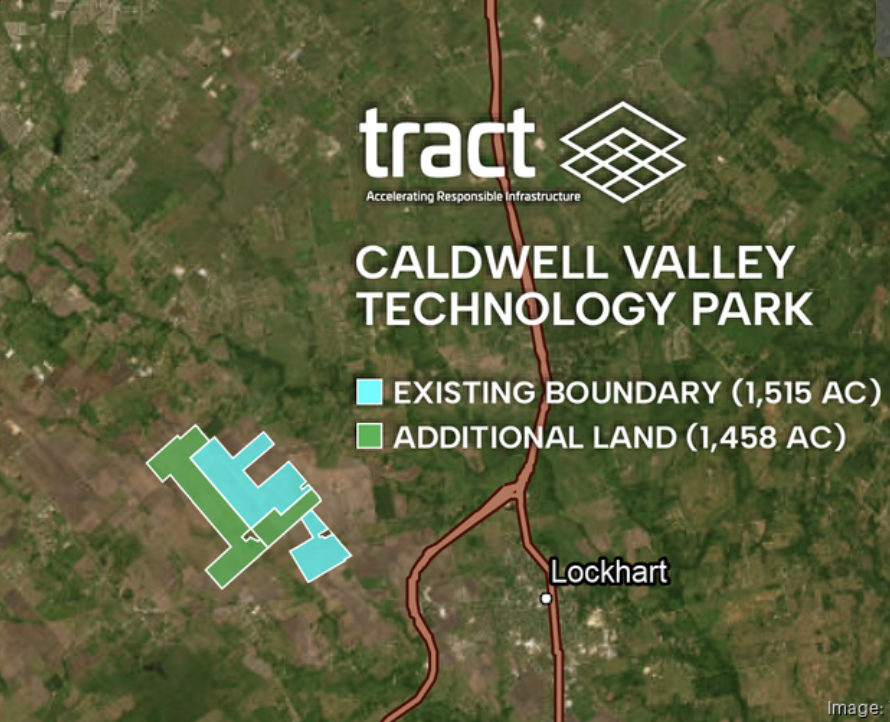
In January 2026, data center park developer Tract had nearly doubled the size of a planned campus in Austin, Texas. The company also announced that it has added 1,458 acres of contiguous land to its existing 1,515-acre Caldwell Valley Technology Park in Caldwell County. The almost 3,000-acre site can reportedly support up to 4GW of data center capacity.
“We are happy to expand in Caldwell County, creating one of the largest data center campuses in Texas that is close to a robust workforce and strategically located for all data center use cases,” said Graham Williams, president of Tract. “The uniqueness of this location and support from our local partners, made it a clear decision to double down on our investments here.”
The company first acquired a 1,515-acre land parcel in Caldwell County, located south of Austin and northeast of San Antonio, in May 2025. At the time, the site, located near the city of Uhland, would reportedly support more than 2GW at full build-out, with the initial 360MW grid connection energized in 2028 in partnership with Blue Bonnet Electric Cooperative.
The site is not under construction yet, but it signals just how large these projects are becoming. Near San Marcos, two additional large facilities are in early planning stages, one by CloudBurst/Energy Transfer targeting a 2026 completion, and another by Highlander SM One LLC on 200 acres.
Texas is clearly positioning itself as a national hub for the infrastructure expected to power artificial intelligence and the next wave of digital transformation.
But there’s a catch.
Most headlines focus on electricity demand, yet experts say water may be the bigger long-term concern. Data centers generate intense heat and must be cooled constantly. Many facilities use evaporative cooling systems, and those systems can consume enormous amounts of water.
A new policy brief from the Houston Advanced Research Center and UH Energy warns that the average midsized data center uses about 300,000 gallons of water per day, roughly the equivalent of 1,000 homes. Larger facilities can use up to 4.5 million gallons per day, depending on the cooling system. While some modern centers use air-cooling or hybrid systems to reduce water demand, many still rely heavily on water-intensive evaporative cooling, particularly in hot, dry regions of the state.
The report cautions that site selection often overlooks long-term water availability. In fast-growing areas already stressed by recurring drought cycles, large data centers could end up competing directly with residents, farmers, and industry for limited water supplies.
“Energy demand gets most of the attention, but water is the hidden constraint,” the brief warns.
Researchers are calling for stronger planning requirements, including water-use disclosures, investment in recycling systems, and prioritizing sites with access to reclaimed or non-potable water. Their message is simple: water is not limitless.
Texas stands to gain billions in investment and thousands of jobs as it becomes a hub for AI and cloud infrastructure. But the digital economy runs on more than electricity, it runs on water too.
As developers race to build the next generation of massive server campuses, state leaders face a growing challenge: how to welcome economic growth without deepening the state’s water stress. Because in Texas, where drought is always lurking around the corner, ignoring water isn’t just risky, it could be unsustainable.