Tragic balloon accident remembered
By LPR Staff
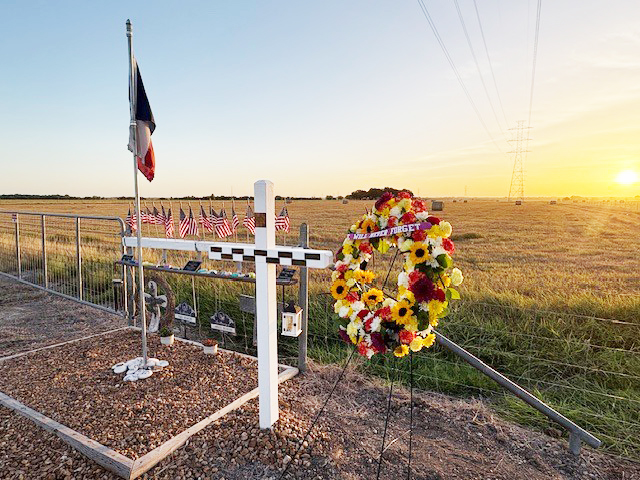
As excitement built for those about to take part in a balloon ride, no one knew in less than an hour the balloon would crash in a field in Maxwell after hitting a high-tension power line, killing all 16 on board. The catastrophe marked the deadliest commercial balloon crash in U.S. history.
July 30 marked the 9th anniversary of the tragedy, which occurred at 7:42 a.m. on a Saturday morning at 730 County Road 230 in Maxwell.
The victims, ranging in age from 23 to 60, and all lived in Texas. Thirteen of the 16 had children. There were six married couples. Almost all of them were celebrating something, either a birthday, an anniversary, even a belated Mother’s Day.
The dead included:
Lorilee Brabson, 48, of San Antonio.
Paige Brabson, 23, of San Antonio.
Matt and Sunday Rowan of San Antonio. They had married 4 months earlier and had a 5-year-old son.
Ross and Sandra Chalk, a married couple from Wimberly.
Scott and Laura Douglas, a married couple from Victoria.
Brian and Tressie Neill, a married couple from San Antonio.
John and Stacee Gore, a married couple from Mineral Springs.
Joe and Tresa Owens, a married couple from Katy, along with Tresa’s best friend, Holly Huckabee.
Alfred “Skip” Nichols, the balloon’s pilot, of Kyle.
The balloon was setting off on its journey from a location at the Fentress Airpark in Caldwell County.
The group were aboard the balloon, which launched at 6:58 a.m. All were ready for what was to be about an hour flight.
Balloon pilot Nichols flew the balloon north.
There are contradictory reports regarding the direction the balloon was heading. In a photo one of the passenger’s had taken at 7:38 a.m., showed the balloon flying above an overcast cloud layer. Another photograph, taken at 7:40 a.m., showed the balloon’s shadow in the clouds and reveals a power line tower.
Suddenly, photos and videos from everyone on the balloon stopped.
The skies had apparently turned foggy during their return flight. According to one expert after the crash, it appeared Nichols knew things were about to get bad because he had his gear in landing mode.
However, at 7:42 a.m. (the time the Lower Colorado River Authority recorded the first power lined being tripped), the balloon descended from a cloud and struck the top wire of a power line. It then dropped onto the high-voltage power lines, and its 340,000 volts of electricity burned through the cables from the envelope to the gondola (or basket) of the balloon. The fuel lines separated from the burner and the gondola plunged to the ground, an estimated 100-foot fall.
It was believed Nichols was likely trying to land the balloon when he hit the power lines after coming downward from a cloud cover.
The fuel lines separated from the burners, spraying liquid propane and igniting a fire.
People living nearby described hearing explosions, then seeing what they believed were car flames.
Propane fuel was ignited as the gondola crashed. It is suspected the fall may have killed the passengers who were not electrocuted to death. Anyone who had survived the electric jolt and the fall burned in the fire. Some victims were unrecognizable and family members had to get dental records to make identifications.
As First Responders arrived, the gondola, which had landed on its side, was still ablaze. First Responders were confused at first as the bodies looked like mannequins.
Even after firefighters extinguished the fire, the chemically enhanced burn from the propane radiated heat, even on a day when temperatures were already well above 100 degrees.
Then Caldwell County head of Homeland Security and Emergency Management Coordinator, Martin Ritchey, had received a call from the county’s EMS director notifying him of a mass fatality in Maxwell. He thought it was likely a large automobile wreck, but while traveling to the scene he discovered it had been a hot-air balloon crash.
“I immediately responded to the scene and ordered the deployment of the Caldwell County Command Trailer and the airspace closure around the incident’s area,” Ritchey said.
Ritchey notified the Federal Aviation Administration (FAA) and asked for the airspace over the area to be shut down, to prevent the flyover of commercial aircraft as well as interested media helicopters. The FAA closed the airspace over the accident site for 5 miles.
Ritchey also contacted then-Caldwell County Judge Ken Shawe, who was vacationing at the Gulf Coast. Shawe declared a state of emergency and placed Ritchey in charge of the crash scene.
A command post was placed on Jolly Road near the crash site. Soon, there were dozens of local and state agencies and support personnel on site. “We activated our County Mass Fatality Plan and opened a family assistance center with the help of Maxwell Fire personnel, the Ebenezer Lutheran Church in Maxwell, and Seton Hospitals,” Ritchey said. “This was done before the accident was made public so we would have a place to direct the family and loved ones of those killed.
“Communication is critical in an event like this. Families’ pain and anguish can only be exacerbated by incorrect information or finding out after something has leaked to social media.”
Ritchey said following the removal of the victims’ remains, crash debris, and investigative materials, arrangements were made for buses to transport family members to the scene.
“This was done before the scene was reopened to the media or the public,” Ritchey said. “Tents, water, counselors, and EMS were on hand to care for those who went to the scene. OEM (Office of Emergency Management) contacted the Lockhart Ministerial Alliance to hold a prayer service at the courthouse square the following weekend.”
Texas Governor Greg Abbott released a statement following the balloon crash, calling it a “heartbreaking tragedy.”
The pilot of the balloon, Nichols, owned Texas Hot Air Balloon Rides despite a very checkered past.
The son of a Vietnam pilot, friends said Nichols struggled with substance abuse for several decades, but believed he was 100 percent sober by the time of the July 30, 2016 flight.
According to a report in Bloomberg News, the 49-year-old Nichols had binged on a cocktail of drugs before takeoff.
A toxicology report showed he had ingested multiple prescription and over-the-counter drugs such as the opiate painkillers Oxycodone, Valium, Prolev, Ritalin and Benadryl. Six of the pills are forbidden by the FAA because they impair a pilot’s judgment and motor skills.
In 2008, the Better Business Bureau had even warned consumers for a third time they should strongly consider not doing business with Nichols. He had a history of canceling flights, problems rescheduling flights, and clients had trouble getting refunds.
In 2009, a former passenger had suffered neck and back injuries after a balloon he piloted crash-landed in St. Louis, saying Nichols had ran out of fuel.
An Austin pilot, David Smuck, told one media outlet he had looked at the weather on the morning of July 30, 2016, and immediately knew weather conditions were unsafe for flying. Winds were higher than his cutoff speed of 19 miles-per-hour. He canceled four flights that day.
However, Nichols had called Lockheed Martin Flight Service for a local weather report, and even thought it was noted there would be a 1,200-foot cloud ceiling with indication of fog Nichols reportedly told them, “Well, we just fly in between them. We find a hole, and we go.”
In 2018, President (Donald) Trump signed the Balloon Safety Act, giving the FAA 180 days to edit a federal regulation mandating medical examinations for aircraft pilots and to include language extending the requirement to include commercial balloon pilots. The law was passed by the FAA and Congress,
Matt Kiely, Justice of the Peace for Caldwell County District 1, said a pilot such as Nichols could have been on a cocktail of drugs with little repercussion. He was on scene at the crash site that evening as bodies were removed. Kiely said truck drivers were put through more difficult testing than balloon pilots.
The FAA issued its discovery report in April 2017, stating, “The accident pilot/operator (Nichols) demonstrated a long-standing, willful non-compliance with regulations. The investigation did not reveal evidence to indicate that the pilot would have likely complied with a requirement for a medical certificate should one [have] been in effect prior to the accident.”
A plan of a lawsuit ensued, but the balloon company claimed bankruptcy, according to Morgan. Nichols had a policy that paid each victim $100,000, but after funeral expenses, some said there was hardly any remaining.
The balloon tragedy in Maxwell was the second largest worldwide only to a 2013 crash that had killed 19 in Luxor, Egypt.