County halts work on Aalo testing facility
By Anthony Collins
LPR Editor
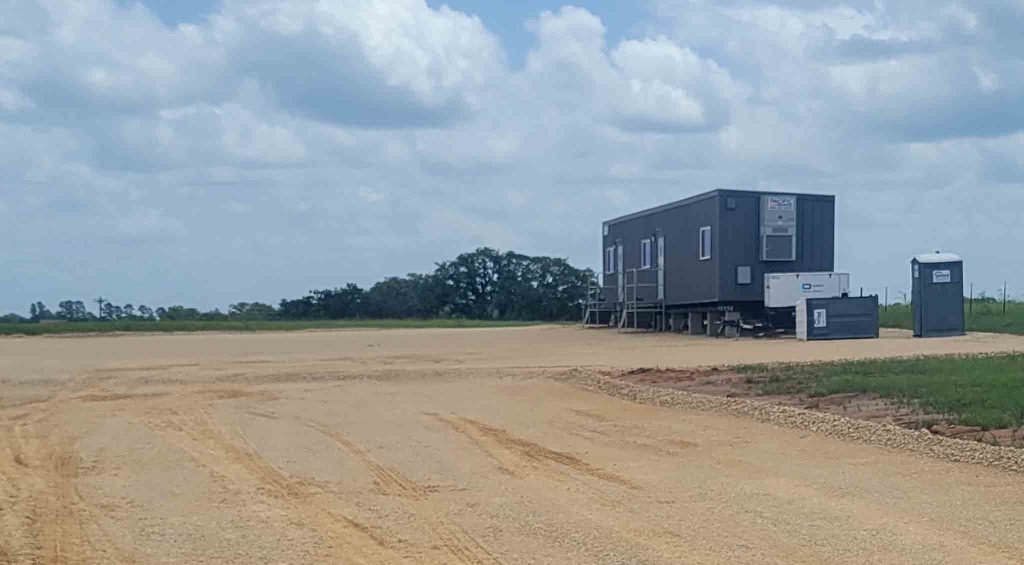
Aalo’s construction site remains halted until permits are issued for future construction.
Photo by Anthony Collins.
Construction of a liquid-sodium testing facility near McMahan has been halted by Caldwell County while the developer works to secure the proper water-well and septic permits. Caldwell County Judge Hoppy Haden said work on the Aalo Atomics project was stopped because the company had not completed the standard permitting process required for commercial developments in unincorporated areas of the county.
According to information provided by the county, Aalo must first obtain a commercial water-well permit through the Plum Creek Conservation District. After securing that permit, the company would then be able to apply for a septic permit through the Caldwell County Sanitation Office. County officials described the process as standard and straightforward. Once the correct permits have been approved and all required conditions have been met, the project would be allowed to continue.
In addition to reviewing the water and septic permits, Caldwell County is exploring whether other regulatory options may apply because the facility plans to use elemental sodium. The county has not announced how long that review could take or whether additional safety requirements may be placed on the project. The construction stoppage provides more detail about an issue that initially created confusion among residents. County officials had previously said Aalo had gone through an administrative review involving a commercial site-development permit, drainage review and a driveway permit.
However, the commercial water-well permit must come before the county can approve the septic system. Because Texas counties generally do not have traditional zoning authority, developments that meet applicable administrative requirements usually do not require a public hearing or a vote by the Caldwell County Commissioners Court.
Aalo is an Austin-based company developing small, factory-manufactured nuclear power plants intended largely to provide electricity for artificial intelligence facilities and data centers.
The McMahan-area project, however, is not planned as a nuclear reactor or power plant. Aalo has said the site will not contain nuclear fuel, uranium or radioactive material. Instead, the facility would be used to test liquid-sodium systems and other non-nuclear equipment connected to the company’s future reactor technology. Plans call for a metal building measuring approximately 60 feet by 60 feet, giving it a footprint of about 3,600 square feet. The building would stand approximately 60 feet tall on an 11-acre property.
Liquid sodium is used as a heat-transfer material in some advanced nuclear reactor designs. Aalo’s proposed commercial system would use sodium to carry heat from reactor equipment to other systems that would eventually generate electricity. The company says sodium can transfer heat efficiently while operating at lower pressure than the water-based systems used in many traditional nuclear plants.
Elemental sodium, however, is not the same as the sodium found in table salt. The material requires specialized handling because it can react strongly with air and water. The Nuclear Regulatory Commission has noted that liquid sodium can also react with concrete. Facilities using the material must therefore include systems designed to prevent leaks and limit the effects of a possible reaction. Water cannot be used to extinguish a sodium fire. Firefighters must instead use suppression materials specifically designed for combustible metals. Those characteristics are among the reasons Caldwell County officials are examining whether additional regulatory authority may apply to Aalo’s use of elemental sodium. In written responses provided for this story, Aalo said protecting employees, nearby residents, farms and the environment would involve careful planning, compliance with construction codes and several layers of safety equipment. The company said the facility would be built so that potential hazards remain contained inside the structure, even during natural disasters.
Although the McMahan property would be a non-nuclear facility, Aalo said the components inside the building would follow the same strict design and fabrication codes the company uses for nuclear equipment. Aalo also said the facility would include redundant safety systems, meaning the failure of one component would not cause the entire safety system to fail. According to the company, sensors would be able to detect a sodium leak and transfer the material into a secure storage tank in less than 10 minutes.
Aalo also pointed to the size of the property as another safety feature. The proposed 60-foot-by-60-foot building would occupy only a small portion of the 11-acre tract, creating what the company described as a substantial physical buffer between the testing equipment and surrounding properties. Those statements represent Aalo’s description of its proposed safety systems. Caldwell County’s continuing review will determine whether the company’s plans satisfy all applicable local requirements and whether other regulations can be used to address the elemental sodium.
Questions have also been raised about whether volunteer firefighters and other emergency personnel in the McMahan area are prepared to respond to an accident involving liquid sodium. Aalo said company representatives met with two local fire departments approximately a year ago to discuss the proposed facility. The company said it plans to provide local emergency responders with walkthroughs of the completed building, along with specialized training related to the testing equipment, elemental sodium and the facility’s safety procedures.
Emergency planning is an important concern for nearby residents because rural fire departments generally operate with fewer personnel and less equipment than departments serving larger cities. Residents have also raised questions about possible effects on nearby homes, livestock, farms, groundwater and property values.
Aalo said its larger mission is to develop small nuclear power plants capable of producing dependable electricity without placing additional pressure on the Texas electric grid. The company believes its future power plants could help protect existing customers from rising electricity costs as more energy-intensive data centers are built across the state. Aalo also said its reactors would generate electricity without producing operational carbon emissions or relying on large quantities of local water.
The company’s planned commercial system, known as the Aalo Pod, would combine five 10-megawatt reactors into a 50-megawatt power plant. The modular plants would be manufactured in sections, transported by truck and potentially installed near data centers. Those plans relate to Aalo’s future commercial nuclear projects and not the non-nuclear testing facility proposed near McMahan. Aalo has developed a separate nuclear test reactor at Idaho National Laboratory. The company reported achieving initial criticality, a controlled, self-sustaining nuclear reaction, at the Idaho facility in early July. The nuclear work taking place in Idaho is separate from the liquid-sodium equipment testing planned in Caldwell County.
Aalo said its growth in Texas could create jobs in manufacturing, construction, engineering, security and other fields. The company operates a pilot component-manufacturing facility in Austin and has said it plans to expand to a larger factory site in Central Texas. That expansion would require additional employees. Aalo also said its projects contribute to local economies by hiring Texas-based general contractors, logistics providers, equipment-rental companies and other vendors.
The company did not provide a specific number of permanent jobs expected at the McMahan facility. Its broader employment projections relate to Aalo’s statewide manufacturing, engineering and reactor-development operations rather than only to the Caldwell County project.
The controversy surrounding the facility has focused not only on sodium safety and permitting but also on when nearby property owners learned what was being built. Several residents said construction was already underway before they received a clear explanation of the project. Some said they felt blindsided by the arrival of an industrial testing operation near rural homes and working farms. Aalo has acknowledged that it should have contacted neighboring property owners sooner.
Company representatives said they want to be good neighbors and should have been more proactive in explaining that the McMahan site would be a non-nuclear testing facility. In its latest response, Aalo said representatives have met with community members and plan to hold additional town hall meetings in the coming months. The company also said it maintains an onsite presence at the McMahan property and is available to answer questions from nearby residents.
For now, construction cannot resume until Aalo obtains the commercial water-well permit through the Plum Creek Conservation District and then secures approval for its septic system from the Caldwell County Sanitation Office. Provided the company meets all conditions, county officials said the standard permitting process would allow the project to continue. The county’s separate review of elemental sodium could also determine whether additional health, safety or environmental requirements apply.