Lockhart weighs decision on downtown at special meeting
By Anthony Collins
LPR Editor
At a special meeting on Feb. 10, the Lockhart City Council dug into what could become one of the most significant redevelopment efforts downtown has seen in years: the future of the current First Baptist Church property.
City consultants from TBA Douglas Architects, told council members the project is financially feasible, but there’s urgency. The church has committed the land for one year, meaning the city is working on a faster timeline than usual. Projects like this can take up to two years just to secure a developer, but Lockhart hopes to move from planning to selection within 12 months.
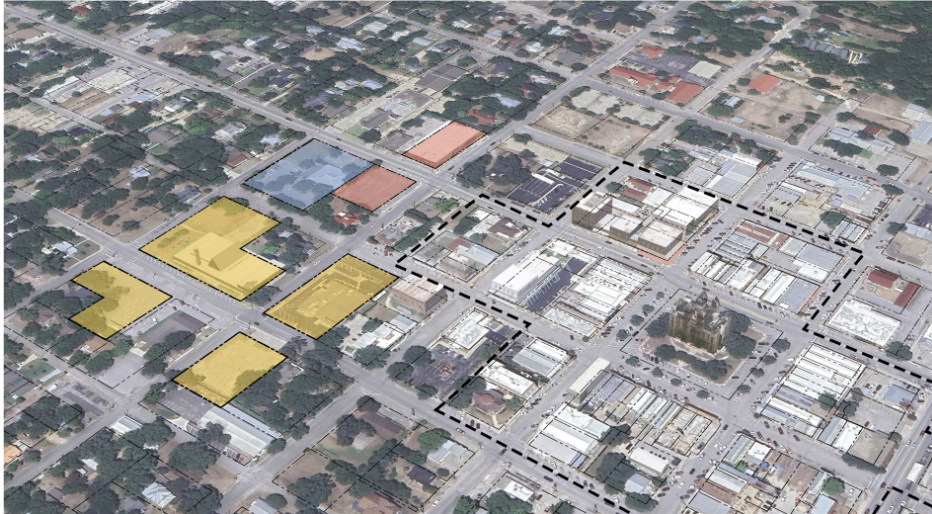
The property includes land owned by First Baptist Church, the City of Lockhart and the Austin Community College District. The ACC owns the former Ford Building and a nearby lot could eventually be part of the larger plan. For now, the city is focused on how existing zoning shapes the possibilities.
Three zoning districts cover the site, allowing a mix of commercial, residential and public uses. In some areas, buildings could technically reach five stories or 60 feet. But while the zoning allows that height, many residents have voiced a preference for something more modest.
Community input has been strong throughout the process. Dozens of residents have attended meetings to hear what the community would like to see in the development of this property. Those survey results show most participants are longtime Lockhart residents. Across the board, the message has been consistent: growth is welcome, but it needs to fit Lockhart’s historic character.
Residents favor three- to four-story buildings built with traditional materials like brick and stone. Step-backs on upper floors are encouraged to reduce visual impact. Protecting views of the courthouse and ensuring new buildings complement, not compete with the historic square are top priorities.
Beyond the buildings themselves, people want a more walkable, inviting downtown. Wider sidewalks, shade trees, plazas, landscaping and safer pedestrian crossings are high on the list. There’s strong interest in restaurants, cafés and outdoor dining, along with family-friendly public spaces and civic gathering areas.
A boutique hotel is generally viewed as a good fit, especially one that supports downtown businesses. Large convention centers or oversized hotels, however, have little support.
That brings up the latest idea under discussion: a small conference-center hotel designed to boost weekday business. Supporters say a modest conference component could attract Monday-through-Wednesday meetings, bringing guests who eat, shop and spend locally. The concept has been described as a “17-hour proposition,” meaning activity that stretches well beyond overnight stays.
Market research suggests there may be demand for this kind of smaller conference product. Still, the proposal is conceptual. There are no renderings yet, only test layouts and financial modeling.
An internal economic analysis is underway to determine whether the numbers work for a developer and whether the city would need to offer incentives.
Location and scale are major sticking points. The site totals about 3.7 acres across four parcels. A full build-out could include up to 140 hotel rooms, compared to the existing 90-room Holiday Inn. Some residents feel three stories would be more appropriate, while four stories is seen as the upper limit.
Neighbors have also raised concerns about traffic, parking, noise from events and operational impacts like grease disposal from restaurant kitchens. Buffer zones and transitional retail space have been suggested to soften impacts on nearby homes.
David Payton, pastor of First Lockhart Baptist Church, confirmed the congregation has voted to sell the property. He said the church wants a high-quality project that benefits the community and noted that if the city does not act proactively, existing zoning could still allow significant development elsewhere. Financially, leaders say the potential upside is meaningful. A project of this type could generate more than $3 million in tax revenue and bring nearly 1,000 residents and employees into the downtown area. Higher density in the central business district is viewed as a way to strengthen the tax base and support preservation of the historic district.
At the same time, some residents worry the process feels rushed. One longtime homeowner told council members his family chose Lockhart in 2001 because they wanted to grow with the town. He urged leaders to slow down and broaden public input, noting that a few dozen participants do not represent a city of 15,000. Another speaker, who owns a historic property dating back to 1870, said she supports thoughtful reinvestment but wants to ensure it enhances, not diminishes, surrounding historic structures.
City leaders say the next steps include forming a steering committee, refining design and buffering strategies and continuing to gather public feedback. A board roster has already been approved, and a meeting schedule is being assembled to keep the process organized.
For now, nothing is final. But one thing is clear: this isn’t just about a hotel or a single development. It’s about how Lockhart grows, and whether it can balance new investment with the character that makes the town feel like home.
Detailed information can be found on www.lockhartedc.com. But here are a few of what the developers and city officials have heard from those in attendance of the public meetings.
1. All meetings have had an audience that has been at least 87% of current residents and no more than 13% non-resident.
2. In meeting two it was relayed that preserving historic character, building height and the use of historic or traditional materials are very important to the community.
3. In meeting three the community input reflected that 51% thought it was important to have a neighborhood grocery store and/or drug store downtown. While the remaining were split at 24% being somewhat important and 24% voting not important.
4. In meeting 3 it was also conveyed that they majority of the group were opposed to modern design followed closely by the new buildings should reflect and compliment the historic square.
5. In regard to parking, community input showed opposition to freestanding garage parking and preferred the use of subgrade parking for the new project.