Harken development moves forward with City Council’s recent approval
By Anthony Collins
LPR Editor
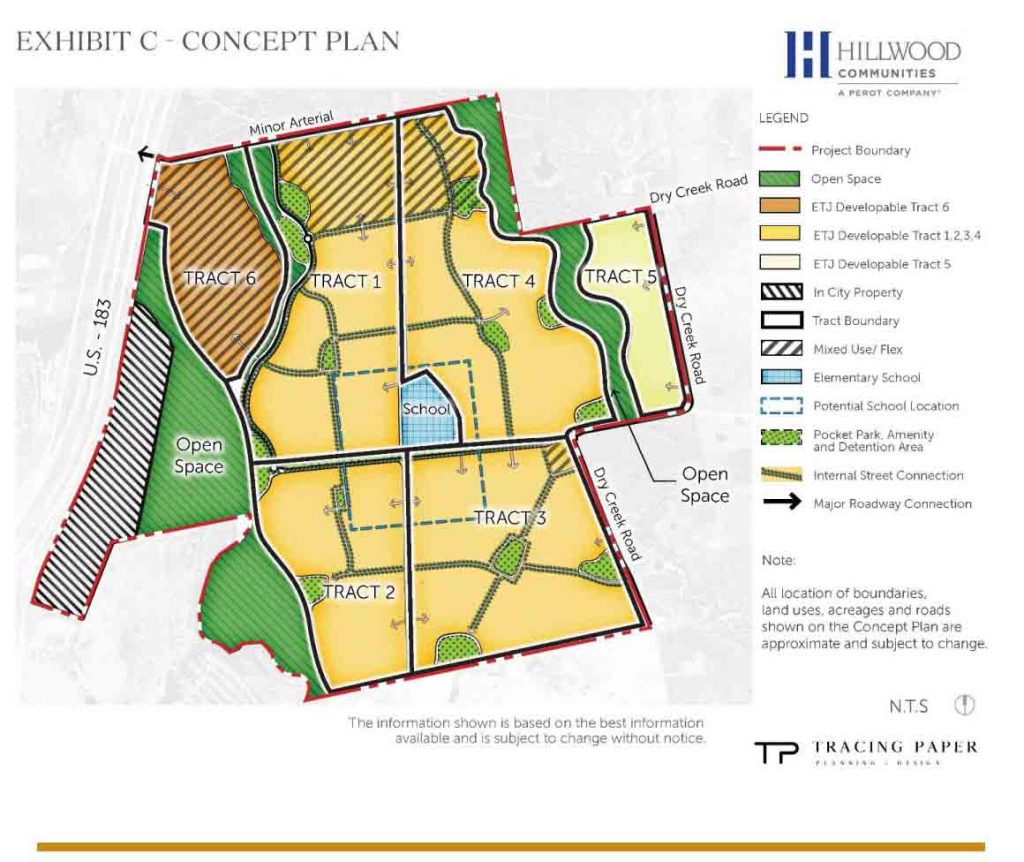
Above. Plans explain the proposed housing development by Hillwood Communities. Photo provided
The proposed Harken Project in Lockhart is making headlines again following the City Council’s Nov. 5 meeting, but the project itself is hardly new. Plans for the massive development, named Spencewood, have been discussed for more than two years, and much of what residents are hearing today was already reported in the July 16 edition of the Lockhart Post-Register.
That article explained details of the proposed development, including thousands of new homes, commercial property, recreational amenities, infrastructure needs, and the possibility of land being donated for a future elementary school.
What has changed is that City Council has now approved agreements that move the project closer to construction. The development is not a new announcement, but the latest approvals represent another significant step toward making it a reality.
Lockhart City Council voted 6-0 to approve a development agreement for the approximately 1,111.2-acre, located east of U.S. Highway 183 and west of Dry Creek Road. The development is being planned by Hillwood Communities and is expected to include approximately 2,600 to 2,700 single-family homes, along with commercial property, multi-family housing, and recreational facilities. The plans to develop approximately 609 acres of residential lots across five phases. Individual lots are expected to range from about 40 to 80 feet wide, allowing several homebuilders to offer different housing styles and sizes. The agreement establishes a framework for development, infrastructure improvements, and financial responsibilities associated with the project.
Council also approved a separate agreement involving Tax Increment Reinvestment Zone No. 2, or TIRZ No. 2, which could help finance eligible public improvements. Caldwell County’s participation in the financing arrangement remains an outstanding step.
The Nov. 5 action follows months of negotiations between Hillwood representatives and city officials. During a June 30 special meeting, Hillwood presented its development plans, construction schedule, and proposed financing arrangements. Those details explained how the proposed neighborhood could develop over the next 10 to 15 years. City Council supported continued negotiations at that time, allowing city staff and the developer to work toward the agreements approved in November. The project has also changed since discussions began in 2024, expanding from an earlier proposal covering approximately 966 acres to the more than 1,100 acres now included in the agreement. One of the biggest issues surrounding the project has been how the infrastructure will be financed. A development this large requires much more than streets and residential lots. Water and wastewater lines, drainage facilities, utility connections, and roadway improvements must be in place before thousands of families can move into the neighborhood. These improvements can cost millions of dollars, and determining who pays for them has been an important part of negotiations. The newly approved agreements are intended to establish how eligible costs may be paid or reimbursed as construction progresses, although final expenses and reimbursements will depend on the terms of the agreements and the development’s progress.
The TIRZ financing arrangement is particularly important because it involves future property tax revenue. A TIRZ allows participating governments to dedicate a portion of the additional property tax revenue generated by rising property values within a designated area toward eligible public improvements. Rather than paying for every improvement immediately, the arrangement allows certain expenses to be reimbursed as development occurs and additional tax revenue becomes available.
City Council approved the final project and finance plan for TIRZ No. 2 on Nov. 5. However, Caldwell County has not yet finalized its participation, leaving an important part of the financing discussion unresolved. The TIRZ also covers a larger area than the Harken development alone.
Another component involves the proposed Lockhart Municipal Utility District of Caldwell County. In September, city council granted conditional consent for a district covering approximately 1,111 acres, including about 1,038 acres in the city’s extraterritorial jurisdiction and 73 acres within city limits. Municipal utility districts (MUD) are commonly used in large Texas developments to help finance infrastructure such as water, wastewater, and drainage systems. Depending on the final district arrangements, property owners within a MUD may pay additional district taxes used to repay bonds issued for qualified improvements. For future homeowners, these financial obligations can become an important part of the overall cost of owning a home. For existing residents, the larger question is how the financing agreements will affect the city’s long-term responsibilities and tax revenue.
The development took another step forward Oct. 8, when City Council approved a zoning change for a portion of the Spencewood property along North Colorado Street.
The zoning approval involved approximately 73 acres and established a Planned Development District for that portion of the property. Although the approval did not cover the entire Harken development, it helped establish the land-use framework needed for future residential and commercial construction. The October decision, followed now by the November development agreement, demonstrates how the project has advanced through several separate government actions rather than receiving approval all at once.
During the June presentation, Hillwood Senior Vice President and Austin General Manager Duke Kerrigan explained that the company is working to attract multiple builders, including discussions with Taylor Morrison and David Weekley Homes. Hillwood indicated that seven or eight builders could eventually participate in the early stages, although interest from builders does not necessarily mean construction agreements have been finalized.
Under the construction schedule, infrastructure work could begin in summer 2027, with approximately 450 residential lots in the first phase expected to be available by fall 2028.
Additional phases would follow as demand and construction progress allow, potentially continuing through 2038. Those dates remain projections and could change depending on market conditions, financing, permitting, and infrastructure availability. Even with the recent council approvals, residents should not expect thousands of homes to appear overnight. The project is designed to develop gradually, with residential construction and additional amenities following the completion of necessary infrastructure.
Harken is also expected to include approximately 38 acres designated for multifamily housing and commercial uses. Those plans include a community farm, sports complex, neighborhood parks, gathering areas, open spaces, and an extensive trail system. The company has discussed creating trail connections that would place homeowners within approximately a quarter-mile of walking and recreational opportunities. An initial community amenity center is targeted for fall 2029. Kerrigan previously explained the company’s vision for the neighborhood, saying, “We consider this site to be a gateway community to Lockhart.” The idea is to create an attractive entrance to the city while offering amenities that could appeal to families relocating from other parts of Central Texas.
The possible donation of 14 acres of land for a future elementary school has also been part of the discussions. But a land dedication does not mean a school has been approved for construction. Lockhart ISD Superintendent Dr. Mark Estrada addressed the district’s involvement in the July 16 Post-Register article, emphasizing that its role concerns planning for future students rather than approving residential developments. “The district is not a party to the development approval process,” Estrada said. The district must evaluate enrollment projections, available facilities, and future funding needs before deciding whether another campus is necessary.
The potential impact on Lockhart’s schools is significant when Harken is considered alongside other planned residential developments. Blue Sky, Moxie, and Juniper Springs are also expected to bring thousands of homes to the community over time. Together, the four developments could account for approximately 10,000 homes if completed as proposed. Those numbers do not include additional projects under consideration elsewhere in the city. The possibility of substantial population growth raises questions about classroom space, transportation, public safety, and the availability of city services.
The growth will place additional demands on roads, utilities, emergency responders, and other public infrastructure. Traffic along U.S. 183 and surrounding roadways will be an important consideration as construction begins. City officials will also need to evaluate the long-term costs of maintaining public improvements and providing services to an expanding population.
Housing affordability remains a question. Although Hillwood intends to offer different lot sizes and home designs, specific home prices have not been announced. Property taxes, insurance, interest rates, and any applicable utility district taxes will influence what buyers ultimately pay.
Harken could eventually become one of the largest residential communities in Lockhart’s history. Whether that growth becomes a lasting benefit will depend on how carefully the city and developer manage the years ahead. The plans have been on the table for some time. The real story now is how those plans will be carried out and what they will ultimately mean for the peo