‘Buen Camino’: Lockhart’s Frank Recio reflects on a 500-mile journey of faith
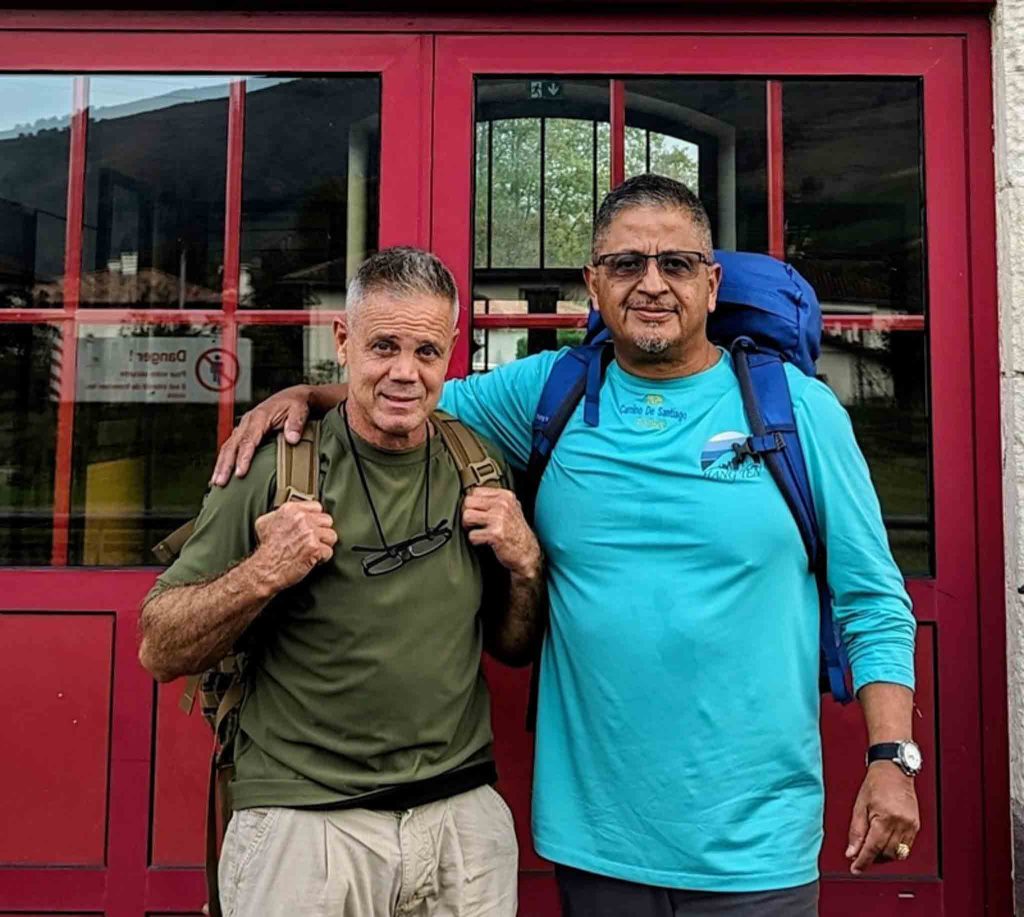
By Anthony Collins
LPR Editor
For more than a thousand years, pilgrims from around the world have traveled the Camino de Santiago, an ancient network of routes leading to the Cathedral of Santiago de Compostela in northwestern Spain, where tradition holds the remains of St. James are buried.
In the fall of 2025, Lockhart resident Frank Recio joined those countless travelers, setting out on a 500-mile spiritual pilgrimage that would test his body, strengthen his faith and deepen lifelong friendships.
Recio, accompanied by longtime friend and retired Marine Lt. Col. Lee Willard, completed the famed French Way of the Camino after 36 days of walking through France and Spain. Their journey began in the small French town of St-Jean-Pied-de-Port on Oct. 16 and ended in Santiago de Compostela on Nov. 20.
For Recio, the pilgrimage had been years in the making. About six years earlier, he first learned about the Camino after watching The Way, the 2010 film directed by Emilio Estevez and starring Martin Sheen. The movie follows a grieving father who travels the Camino in honor of his late son. The story resonated deeply with Recio.
He soon discovered the Camino was much more than a hike. For centuries, pilgrims have walked the route for reasons ranging from spiritual growth and self-discovery to redemption, healing and personal challenge. “For me, I wanted to complete this pilgrimage as a way of giving thanks to God for a blessed life,” Recio said.
Retirement finally gave him the time needed to attempt the demanding trek. But before leaving, Recio shared his goal with his longtime friend Lee Willard, a fellow Marine and ROTC brother from their days at the University of Texas at Austin. Willard immediately expressed interest in joining him.
Rather than travel alone, Recio waited another year for Willard to retire so the two could undertake the pilgrimage together. That friendship became one of the defining themes of the journey.
The two men first met more than 40 years ago while in ROTC at UT Austin. They were commissioned on the same day and remained close despite living hundreds of miles apart for much of their adult lives.
The Camino, Recio said, gave them a rare opportunity to reconnect on a deeper level. “We shared stories, sorrows, troubles and victories,” he said. “We had to learn how to get along and accept each other’s idiosyncrasies. Best of all, we are still friends after meeting over forty years ago.”
But before the pilgrimage became meaningful, it first became painful. Recio described the first day as the toughest challenge of the entire Camino. The pair climbed nearly 4,750 feet over 11 miles while crossing the Pyrenees Mountains that separate France and Spain. After the exhausting ascent came a punishing descent along rocky trails that battered their knees and feet.
By the time they arrived at their first Albergue, a pilgrim hostel in Roncesvalles, Spain, both men were physically drained. “We were in pain, exhausted and dehydrated,” Recio recalled. “It was more challenging than expected.”
The struggle continued into the second night when they reached the town of Zubiri. Recio said his body had become so stiff he could barely move while lying in his bunk bed. That night, desperate for strength, he prayed before falling asleep. What happened next remains one of the most meaningful moments of the entire pilgrimage.
Recio dreamed of his grandmother, Catalina. “I felt her presence,” he said. “When I woke up the next morning, my pain was gone and I felt refreshed and ready to go.”
To Recio, the experience felt spiritual, a blessing that carried him forward through the remainder of the pilgrimage. Along the route, Recio and Willard passed through breathtaking countryside, medieval villages and centuries-old cathedrals. They stayed in Albergues built hundreds of years ago, including one dating back to the year 900.
The beauty of the journey extended beyond the scenery. Recio said one of the most memorable parts of the Camino was the camaraderie shared among pilgrims from around the world. Travelers from Canada, Ireland, Croatia, Germany, South Korea, Japan, Peru and even Texas crossed paths daily, often sharing meals, stories and encouragement.
During the final two weeks of the pilgrimage, Recio and Willard were joined by a 21-year-old Irishman named Daniel, who had just graduated college and decided to complete the Camino before beginning his career. “Imagine that” Recio said. “The generation gap didn’t matter to him or to us.” The pilgrims often formed temporary families, bonding quickly despite coming from vastly different backgrounds and cultures.
“As pilgrims, we were brought together especially when sharing spaces in the Albergues,” Recio said. “We shared stories, shared food, cooked and cleaned together, and prepared for the next day.” The kindness of locals also left a lasting impression. As pilgrims passed through towns and villages, residents frequently greeted them with the traditional phrase “Buen Camino,” meaning “Good Way” or “Good Journey.” Some locals offered fruit from their fields or wine from their cellars. Others helped direct travelers back onto the correct path whenever they strayed.
Still, the Camino was not without emotional challenges. About two weeks into the journey, Recio woke up feeling physically and mentally drained. Discouraged, he told Willard to continue ahead while he walked alone and tried to regain his energy. Then came another moment he still considers extraordinary.
As he walked beneath an overpass during sunrise, he noticed graffiti painted on the wall. It read: “Frank, you can do it!” “I felt like it was there specifically for me,” Recio said. “My enthusiasm returned.”
One of the pilgrimage’s most emotional moments came during an encounter with a woman from Mexico. While walking together, the woman shared that she had recently lost her 17-year-old son in an accident and was walking the Camino in search of strength and healing.
Recio initially struggled to find the right words. After expressing his condolences, he walked ahead before realizing he needed to turn back. “I went back to give her a shoulder to lean on,” he said. “After a few moments of sharing, we hugged.” That moment reminded him of a saying he later discovered after completing the pilgrimage: “Blessed are you pilgrim, if you discover that one step back to help another is more valuable than a hundred forward.”
For Recio, the Camino became more than a physical journey. It became a metaphor for life itself. “The Camino reinforced my belief that there is more good than bad in the world,” he said. His faith, he added, grew stronger with every mile. “The Camino is a metaphor of life,” Recio said. “Faith in Jesus Christ will grant a person the inner strength to safely cross the highest mountains and lowest valleys.”
Now back home in Lockhart, Recio encourages others to consider the pilgrimage if they ever feel called to it. He advises future pilgrims to train by walking several miles daily, invest in proper hiking gear and perhaps most importantly take their time. “Walk the Camino at your own pace,” he said. “Take in and enjoy the beauty. Enter the churches and cathedrals. Converse with the locals. Enjoy the experience.”
He also fondly remembers the food and culture encountered along the route: Galician soup, Burgos sausage, paella, octopus, fresh-squeezed orange juice, local wines and strong Spanish coffee. For Recio, however, the greatest reward was not the destination itself, but the journey. “It’s what you don’t do that you regret when you get older,” he said. “If the desire is there, go for it. You can do it. Buen Camino.”