Crowd turns out as data center debate heats up
By Anthony Collins
LPR Editor
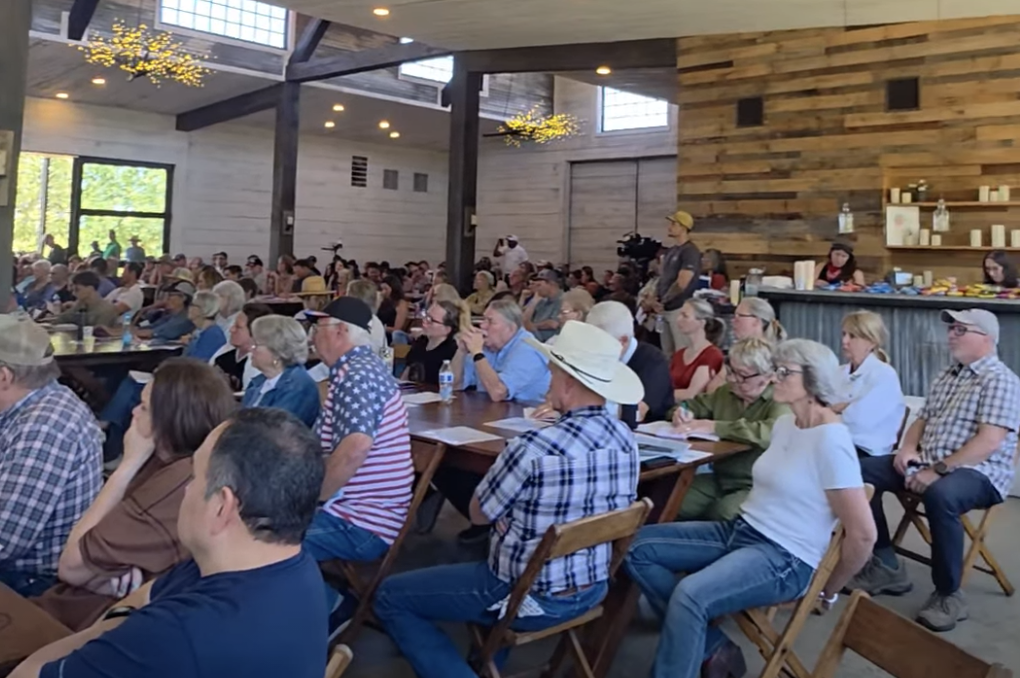
Approximately 300 people attended a recent town hall meeting to discuss the potential development of large-scale data centers, reflecting growing public interest and concern about how such projects could shape the county’s future.
County Judge Hoppy Haden opened the discussion by outlining a key limitation facing local officials: by the time developers approach the county, they have typically already purchased the land. As a result, the county has little authority to prevent projects from moving forward. But they do have a little bit of teeth they can use in cases like these.
Under current Texas law, counties lack zoning authority, restricting their oversight to reviewing drainage and engineering plans and issuing certain permits. In response, Caldwell County relies on development agreements as its primary tool for influencing projects, negotiating terms with developers before considering any tax abatements.
Through these agreements, county officials have sought to establish environmental safeguards and operational standards. Requirements include the use of closed-loop cooling systems, restrictions on water consumption, and the use of non-potable water sources whenever possible. For example, a 100-megawatt data center would be limited to approximately 20,000 gallons of water per month, a level officials say is comparable to the usage of a small number of households.
Additional provisions address wastewater treatment, pollutant reduction prior to discharge, and “dark sky” lighting aimed at minimizing light pollution. Haden, who has a professional background in water quality, emphasized that protecting local water resources remains a top priority.
The discussion also included input from a data center industry representative in attendance, though no developers were part of the official panel. A CEO with one of the proposed projects spoke to evolving industry standards, noting that some commonly circulated concerns may be outdated.
“The industry is changing tremendously,” the representative said. “If you look at where things are headed, data centers are moving toward net-zero operations. They’re becoming water positive and working to capture carbon from their power generation.”
The remarks highlighted a growing divide in perspectives, as some see technological advancements as a path toward reducing environmental impact, while others remain skeptical.
The discussion also turned to the potential financial impact of such developments. Haden noted that early estimates indicate the county could receive between $14 million and $20 million annually through agreements tied to tax abatements. He suggested that revenue at that level could allow the county to invest in farmland preservation, an effort that is currently beyond its financial capacity.
“If we receive that kind of funding, the county could purchase farmland and place it into a conservancy,” Haden said, adding that partnerships with organizations such as the Luling Foundation could allow land to remain in agricultural use.
Not all attendees were persuaded that the benefits would outweigh the risks. Bobby Levinsky, an attorney with the Save Our Springs Alliance, encouraged residents to remain actively engaged and to challenge projects when possible.
“Delay right now is our friend,” Levinsky said. “We’re at an inflection point, and without action, the impacts could be difficult for the state to sustain.”
Speakers also raised concerns about water usage in a region already facing drought conditions, urging greater transparency from developers and recommending the use of treated wastewater rather than potable water for both data center operations and associated power generation.
Haden responded by emphasizing that development agreements include measurable limits on water use, along with significant penalties for noncompliance.
“We are putting clear, enforceable numbers in place,” he said. “If those limits are exceeded, there will be consequences.”
Several participants also highlighted the need for stronger state-level involvement. Attention was drawn to Senate Bill 6, which would require large energy users, including data centers, to bear more of the cost of connecting to the electric grid. However, the measure is not expected to be considered until the 2027 legislative session.
Residents were encouraged to begin engaging with state lawmakers now rather than waiting for the next session, with speakers emphasizing the importance of sustained public involvement.
Despite invitations extended to elected officials, only a staff member from the office of State Sen. Judith Zaffirini attended the meeting.
By the conclusion of the forum, it was clear that while opinions remain divided, community interest is strong. Attendees left with a clearer understanding of both the opportunities and challenges posed by data center development, as well as the significant role public input may play in shaping future decisions.
When asked what was an expected outcome for town halls like this, Pat Stroka commented, “Our end game is to give Caldwell County residents the most up to date information and to inspire them to contact their representatives for needed legislative relief.